KEY FACTS PPWR

The European Green Deal (2019) set the stage for the EU’s sustainability transformation with the objective of achieving climate neutrality by 2050.
It emphasised the need for sustainable product design and better resource management which are the key elements of the Circular Economy Action Plan (CEAP).
This laid the groundwork for the new Packaging and Packaging Waste Regulation (PPWR).
WHAT IS PPWR?
| New EU Regulation: | The Packaging and Packaging Waste Regulation (PPWR) replaces the previous Packaging and Packaging Waste Directive (94/62/EC) from 1994. |
| Purpose: | Strengthened requirements to improve packaging circularity and reduce packaging waste. |
| Direct Applicability: | PPWR applies immediately across the EU without national transposition. |
| Binding Date: | Fully binding from August 12, 2026. |
| Gradual Implementation: | Requirements will be phased in between 2026 and 2040. |

Compliance will be complex, with multiple sources of data required.
Businesses need to act early to ensure they can meet the deadlines.
WHY IT MATTERS?
KEY OBLIGATIONS
The PPWR represents a major shift from the Directive and aims to regulate the entire lifecycle of packaging – from design, composition, and manufacture to end-of-life waste.

ECO DESIGN REQUIREMENTS
PPWR objectives:
Only packaging in conformity with the sustainability and labelling requirements under PPWR can be placed on the EU market.
Obliged party:
This shall be the company that has the most influence on the design specification for that packaging.

EPR REQUIREMENTS
Objective:
Finance the packaging waste
disposal infrastructure in the
Member State where their
packaging becomes waste
(known as Extended Producer
Responsibility or EPR).
Obliged party (the Producer):
This must be a company that
has the closest connection to
the Member State where the
packaging becomes waste.
WHAT ARE THE KEY REQUIREMENTS FOR ECO-DESIGN?

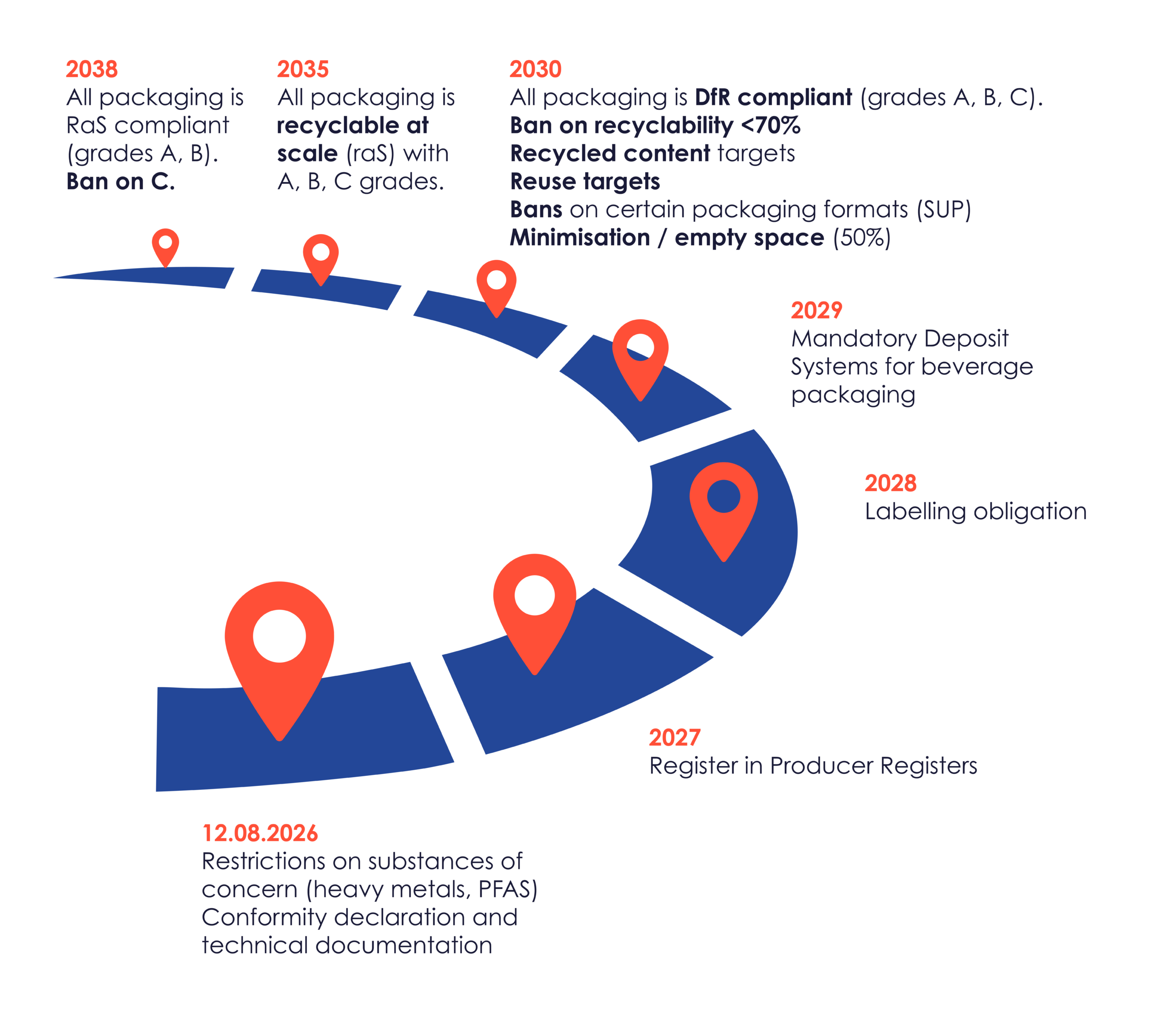
Substances restrictions (Art. 5), as of 12 August 2026
Strict limits apply to substances of concern like heavy metals and PFAS in food‑contact packaging. There are no transitional periods for existing inventory.
Recyclability (Art. 6), as of 2030
All packaging must meet Design for Recycling (DfR) criteria and achieve a recyclability performance class of A (≥95%), B (≥80%), or C (≥70%). Packaging below 70% recyclability is prohibited from 2030.
Recycled content (Art. 7), as of 1 January 2030
Plastic packaging must contain a minimum level of post‑consumer recycled content, depending on the packaging type.
Biobased feedstock (Art. 8), as of 2028
Plastic packaging made of biobased feedstock (e.g. PLA) should be designed for recycling without affecting other waste streams.
Compostable packaging (Art. 9), as of 12 February 2028
Only a few formats must be compostable, including tea and coffee bags, certain single‑serve units, fruit and vegetable stickers, and light carrier bags.
Minimisation of packaging and empty space (Art. 10 and 24), as of 1 January 2030
All packaging must be reduced to the minimum weight, volume, and number of layers necessary. Oversized packaging and deceptive design (e.g., false bottoms, double walls) are prohibited.
Reusability (Art. 11), as of 2030
The PPWR will introduce reuse targets for packaging used for different applications, such as for transport and beverages.
Labelling and traceability (Art. 12, 15 and 18), as of 12 August 2028
All packaging must carry a harmonised EU sorting label showing material composition and how to dispose of it.
EU Declaration of Conformity (Art. 35-39 – annexes VII/VIII), as of 12 August 2026
Producers must provide a declaration of conformity (DoC) confirming that their packaging complies with all PPWR requirements and keep the supporting documentation for several years. The DoC must include: description of packaging, materials, applied standards, recyclability/minimisation/reusability assessments, and test reports.
Sales bans (Art. 67 and 25, annex V), as of 2029/2030
The PPWR introduces targeted sales bans on unnecessary, non‑recyclable, or environmentally harmful packaging formats, including certain single‑use plastic items such as portion packs and sachets.
WHAT ARE THE KEY REQUIREMENTS FOR EPR?
PPWR aims to harmonise the EPR obligations introducing the obligation to register with national register(s) and join Producer Responsibility Organisation(s) or PROs. The EU will also harmonise the format for registration and data reporting, even if some differences among Member States are allowed in specific cases.
Registration in national packaging register(s)
From 12 August 2026, all producers must register in the national packaging registers of every EU Member State where their packaging becomes waste; registration is mandatory for all packaging types.
Participation in PROs
Producers must join a PRO in each Member State in which they operate, as this becomes compulsory from 12 August 2026 for all packaging types.
Reporting packaging data
Producers must submit packaging data reports to national registers, using reporting formats defined by EU implementing acts; the granularity increases significantly for companies >10 tonnes of packaging per year.
Payment of EPR fee
Producers must pay EPR fees to PROs for all packaging they place on the market, and from 2030, these fees will be eco‑modulated based on recyclability performance grades (A–C).
Appointment of Authorised Representative(s)
Where required, producers must appoint a national authorised representative to fulfil EPR duties in Member States where they are not established; this obligation applies from 12 August 2026 depending on national rules.